
Blog
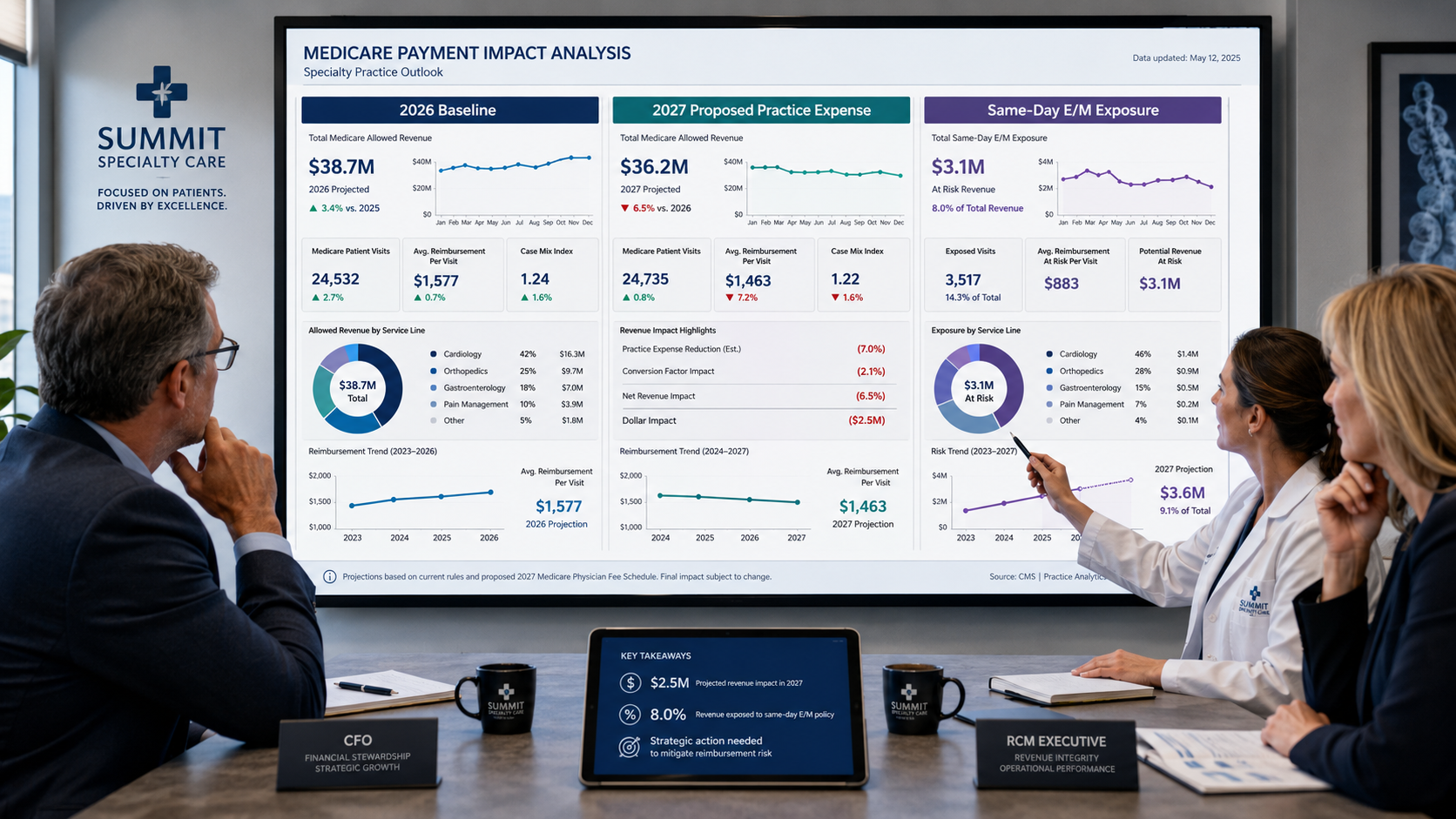
The 2027 Payment Squeeze: How Practice Expense and Same-Day E/M Changes Could Affect Specialty Revenue
CMS's proposed CY 2027 fee schedule changes could squeeze specialty revenue through revised practice expense rules and reduced same-day E/M payments. Here's how to measure your exposure before the final rule hits.

CMS Is Expanding Audits Nationwide: How MIPS Providers Can Prove Their Data Holds Up in 2026
In 2026, CMS is expanding audits beyond Medicaid into MIPS. Audit defensibility, proving every reported number with clinical documentation, now matters more than on-time submission. Most failures stem from missing documentation or misaligned EHR data. The question is no longer whether you submitted. It is whether you can stand behind every number you reported.

The First Data Failure That Derails MIPS Scores
Most MIPS failures don’t happen at submission—they start months earlier when clinical intent and data structure drift apart. This Compliance Foundations Guide from Chirpy Bird reveals how early data misalignment quietly derails MIPS scores and shows the practical steps providers can take to prevent downstream reporting errors, stabilize performance, and strengthen audit readiness

The Hidden Cost of Attribution Drift: Why ACO Performance Breaks Long Before Scores Are Released
Many ACOs quietly lose ground on performance in Q1, long before quality scores or shared savings reports arrive. Attribution drift—when the population you are accountable for no longer matches how care is staffed, managed, and delivered—silently erodes care management efficiency, quality measure performance, and financial predictability. Left unmanaged, it turns January’s “quiet” reporting period into the moment when performance problems are locked in for the rest of the year. This article explains how attribution drift starts, the early warning signs leaders should watch, and how proactive attribution governance can protect both outcomes and teams by treating attribution as a core leadership responsibility, not a static CMS output.

September 2025 CMS Preview Period Reopened: What LTCHs and IRFs Need to Know About the Corrected Quality Reports
CMS has reopened the September 2025 Preview Period for LTCH and IRF quality reporting. Learn what's changed, which measures were corrected, and what providers must do by the August 28 deadline to protect their Medicare Compare scores.

2026 MIPS Proposed Rule: What’s Changing with Traditional MIPS?
The Centers for Medicare & Medicaid Services (CMS) has proposed key updates for the 2026 MIPS performance year, including unchanged category weights, a stronger push toward digital quality measures (dQMs), and adjustments to measure inventories and performance thresholds. Clinicians and administrators should prepare for evolving MIPS Value Pathways (MVPs), streamlined reporting, and increased digital reporting requirements. Stay ahead by reviewing the proposed changes and ensuring compliance before the final rule takes effect.

Action Guide: CMS’s 2025 Third-Party Intermediary Policy Changes
Discover CMS’s 2025 third-party intermediary policy changes for MIPS providers and get clear, actionable steps to update vendor agreements, test workflows, and meet deadlines.

What Is a MIPS Security Risk Assessment (SRA)?
A Security Risk Assessment (SRA) isn’t just another checkbox for MIPS—it’s a critical safeguard for your practice’s data and Medicare compliance. By identifying vulnerabilities in how you protect patient health information (PHI), an SRA helps you avoid breaches, fines, and lost trust—while securing full Promoting Interoperability points. Follow our step-by-step guide to streamline your SRA process and stay ahead of CMS requirements in 2025.

Meeting the Minimum PI Data Submission Requirements (A Tutorial)
Learn how to meet the 2025 Promoting Interoperability minimum data submission requirements under MIPS. This step-by-step guide helps providers and practice managers ensure compliance, avoid penalties, and optimize EHR reporting.

Understanding Topped-Out Measures and Their Impact on Your 2025 MIPS Scores
Topped-out measures—where most clinicians score near the benchmark ceiling—can hurt your MIPS Quality score even if your care is excellent. In 2025, CMS is adjusting scoring, removing outdated measures, and adding new opportunities. Here’s how to adapt:
Key Changes:
No More 7-Point Cap: Topped-out measures in specialty sets can now earn full points if meaningful variation exists.
Annual Topped-Out List: Check the Federal Register (published June 1) for measures flagged for removal or adjustment.
New High-Value Measures: CMS added 7 new measures, including patient-reported outcomes (e.g., pain post-chemotherapy).
Pro Strategies:
✔ Diversify: Replace topped-out measures with high-weight alternatives.
✔ Track in Real Time: Use dashboards and weekly huddles to monitor performance.
✔ Leverage Registries: Ensure your QCDR/EHR reflects 2025 benchmarks and test submissions early.
Act Now: Don’t let topped-out measures drag down your score. Innovate with new measures, optimize reporting, and protect your incentives.

Risk Adjustment 2025: Using Hierarchical Condition Categories to Protect Your MSSP Benchmark
CMS’s seismic shift to HCC V28 is here—and if your ACO isn’t prepared, your RAF scores could plummet, slashing your Medicare Shared Savings Program (MSSP) benchmarks regardless of patient outcomes.
The Urgency:
67% of 2025 RAF scores now hinge on V28’s stricter rules—more HCCs, reweighted conditions, and brutal specificity demands.
Chronic conditions like CKD Stage 3 no longer count unless paired with complications. "Diabetes" alone won’t cut it—documentation must detail complications (e.g., "diabetes with neuropathy").
Benchmarks = Revenue. Miss the mark, and shared savings vanish—or worse, your ACO triggers shared losses.
Your Survival Kit:
Audit Top Codes – Does your #1 diagnosis still map to an HCC?
Train Clinicians – V28 demands precision. "Good enough" notes = financial risk.
Leverage Annual Wellness Visits – Embed HCC recapture into every AWV.
Adopt MEAT Criteria – Every diagnosis must show ongoing Monitor, Evaluate, Assess, Treat.
Track Quarterly – Don’t wait for December—run RAF reports now.
By 2026, V28 is 100% in effect. Delay = years of disadvantage.
Protecting your benchmark isn’t optional—it’s survival.

Value Pathways 2025: Mapping Your Practice to the New Primary Care MVP
2025’s MVP Shift: Why Ignoring Cost Could Sink Your MIPS Score
Cost isn’t just another category—it’s 30% of your score, calculated retroactively with no do-overs. While most providers focus on Quality and IA, CMS is tightening value-based benchmarks. Fall behind, and you’ll lose revenue without realizing why.
The Hidden Risks:
Peer benchmarking means you’re graded on spending efficiency—whether you track it or not.
High-cost episodes (like avoidable hospitalizations or duplicative testing) tank performance.
No data submission required—CMS auto-calculates based on claims, so you won’t know there’s a problem until it’s too late.
3 Tactical Fixes:
Audit past performance – Pull your QPP cost reports to pinpoint problem areas.
Drill into episodes – Compare costs per condition (e.g., diabetes, COPD) to peers.
Preempt outliers – Streamline referrals, reduce low-value care, and close care gaps early.
The Bottom Line:
Cost isn’t passive. Act now—or let CMS penalize you for overspending you didn’t even know about.

ACO 2025 Contract Refresh: Choosing Between Pathways to Success Tracks
The 2025 Medicare Shared Savings Program (MSSP) update presents a pivotal moment for Accountable Care Organizations (ACOs). With CMS emphasizing performance accountability and health equity, ACOs must decide: Does our organization have the agility, financial resilience, and technology to thrive under Pathways to Success—and which track (Basic or Enhanced) aligns with our vision?

The MVP Shortcut Every Primary Care Practice Needs
What if you could satisfy MIPS requirements without tracking new metrics? MVP M0005 rewards primary care practices for work they’re already doing—hypertension management, diabetes control, and routine screenings. In this guide, we’ll show you how to:
Identify 5 measures your clinic is already documenting
Assign ownership to staff without adding burnout
Transform everyday workflows into Medicare bonuses
Plus, download our free toolkit with EHR templates and reporting checklists to start optimizing today.

URGENT: CMS Suspends 8 MIPS Improvement Activities for 2025
CMS suspends 8 key MIPS improvement activities for 2025. Discover which activities are out, how to replace them, and urgent steps to protect your Medicare payments. Updated 2024 guidelines inside.

ACO Strategy Guide: Choosing Your Pathway with Confidence
The 2025 Medicare Shared Savings Program (MSSP) refresh brings critical updates for ACOs—including new risk tracks, quality benchmarks, and payment incentives. Whether you’re a new or experienced ACO participant, choosing between BASIC, ENHANCED, and ENHANCED+ tracks will shape your financial and operational success.

MIPS Monday: MIPS 2025 Kick-Start – 3 Quick Wins to Secure Your Quality Score by Q2
Maximize your MIPS 2025 score by excelling in the Promoting Interoperability category. Learn key objectives, required measures, Security Risk Assessment (SRA) essentials, and practical strategies to stay organized and compliant all year long.

Maximizing Your Promoting Interoperability Points in MIPS 2025
Maximize your MIPS 2025 score by excelling in the Promoting Interoperability category. Learn key objectives, required measures, Security Risk Assessment (SRA) essentials, and practical strategies to stay organized and compliant all year long.

10 Best Practices for the Revenue Cycle Management Process in Medical Billing
Discover 10 best practices for the revenue cycle management process in medical billing to enhance efficiency and compliance.

No More COVID and Cyberattack EUC Exemptions – Why MIPS Compliance Matters in 2025
Stay on track with CMS MIPS 2025! Learn key updates, strategies for success, and download our free planning guide to simplify your reporting and avoid penalties.