
Blog

Your Benchmark Exposure Review Should Start Before the Final Benchmark Arrives
By the time CMS delivers a final benchmark, most of what shaped it is already in motion. Here is a five-step Benchmark Exposure Review ACO leaders can run early, while there is still time to respond.
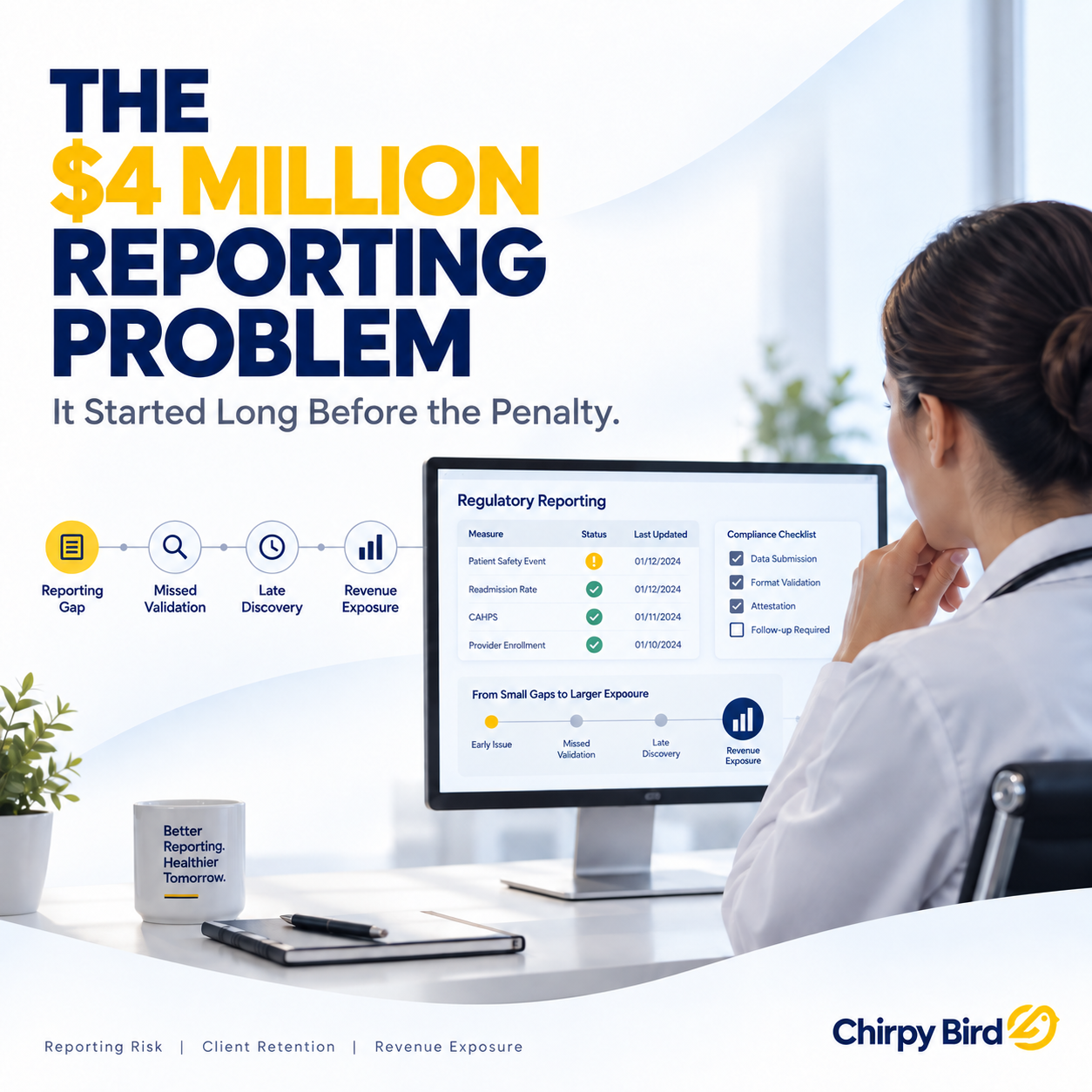
The $4 Million Reporting Problem That Started Long Before the Penalty
A projected $4M MIPS payment exposure didn't start with one bad score. It started with unowned signals, weak escalation, and validation that came too late.

Seven Compatible Registries Do Not Mean Seven Equivalent Choices
CMS ended ModMed's Qualified Registry status for MIPS Quality reporting starting in 2027. ModMed offers seven compatible registries, but compatible isn't the same as qualified. Here's how to evaluate the real choice.
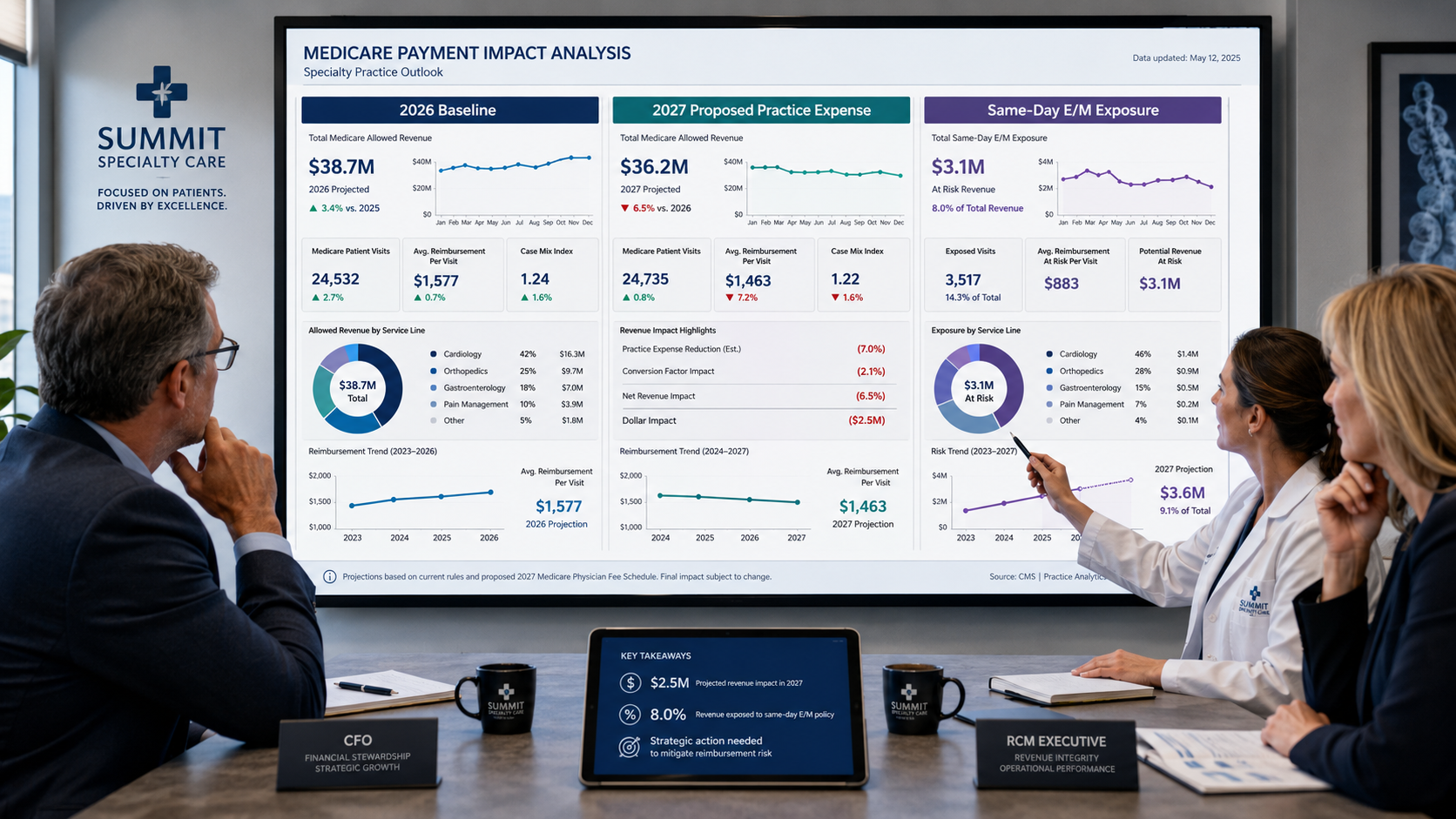
The 2027 Payment Squeeze: How Practice Expense and Same-Day E/M Changes Could Affect Specialty Revenue
CMS's proposed CY 2027 fee schedule changes could squeeze specialty revenue through revised practice expense rules and reduced same-day E/M payments. Here's how to measure your exposure before the final rule hits.

APP Plus in 2027: Your Reporting Pathway Is Now a Strategic Decision
CMS’s proposed 2027 APP Plus changes could give MSSP ACOs more reporting flexibility, but selecting a pathway is no longer just a quality-reporting decision.
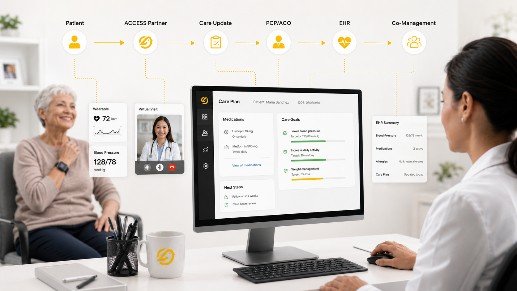
CMS ACCESS Model 2026: What ACOs and Primary Care Practices Need to Know
The ACCESS Model Is Live: Before You Refer a Patient, Map the Workflow

The Next RCM Advantage Starts Before the Claim
Revenue risk often begins long before a claim reaches the billing office. Gaps in provider enrollment, documentation, authorization workflows, quality reporting, interoperability, or evolving CMS requirements can lead to denials, rework, missed performance opportunities, and audit exposure.

There’s No Opting Out of This One: ASM Enters Year One in 2027
Medicare's first mandatory specialist accountability model, the Ambulatory Specialty Model (ASM), takes effect January 1, 2027, targeting cardiologists and spine/pain specialists in roughly 25% of U.S. metro areas. Unlike voluntary value-based initiatives, ASM has no opt-out or hardship exemption. Participating clinicians face payment adjustments from -9% to +9% in Year One, based on quality, cost, care improvement activities, and interoperability metrics. The CY 2027 proposed rule represents the final opportunity to shape operational details before go-live. Affected practices must act now to confirm participant status, build care coordination infrastructure, and prepare for performance scoring that begins January 1, 2027.

The August 2026 Compliance Pressure Map: What Practices Need to Watch
August is not a waiting month for healthcare leaders. With the MSSP RFI-1 deadline on August 5, the ACCESS Model rolling start on August 17, and ASC comments due by August 31, operational action is required now. Separating submission deadlines from decision points is critical to avoid compliance gaps. This pressure map helps ACOs, specialty groups, and ASCs transition from shared awareness to tangible accountability. By assigning ownership and preserving evidence, you can turn the CMS calendar into a controlled operating process rather than a series of administrative reminders. Start building your 2027 strategy before the September PFS deadline.

Active Engagement Is Not a Feeling: How to Prove Public Health Reporting for PI
Active engagement is not a feeling. It's a status your practice must prove. For 2026 MIPS Promoting Interoperability, CMS requires documented evidence for Immunization Registry Reporting and Electronic Case Reporting. A working interface isn't enough. Your practice needs registration confirmations, active engagement levels (Pre-Production/Validation or Validated Data Production), registry communications, and interface status documentation. Optional TEFCA reporting offers bonus points but requires real proof of participation. Don't rely on vendor claims or memory. Build a proof file now while the reporting period is active. Missing documentation creates compliance risk. Check your evidence today.

CMS Just Put a Date on the End of Traditional MIPS
CMS just named the end date for traditional MIPS: CY 2028 is the last performance year. Starting in CY 2029, MVPs become mandatory for every non-APM clinician; the question is no longer if you need an MVP strategy, but which one and by when.

Your PI Proof File Should Be Taking Shape Now. Is It?
Your 2026 Promoting Interoperability score is already being built, which means your evidence file should be taking shape too. A PI Proof File is not a submission-season accessory; it is your practice’s scorekeeper. It moves your team from "we think we are ready" to "we can prove we are ready" by centralizing CEHRT documentation, Security Risk Analysis evidence, public health reporting status, and attestations. Don't rely on good intentions or scattered inboxes. Build a defensible record that connects the dots between your technology, your workflows, and your MIPS submission to ensure you can produce proof when it matters most.

If You Bill Under More Than One TIN, This APM Proposal Is for You
CMS proposes moving Qualifying APM Participant (QP) determinations from the NPI to the TIN/NPI level—closing a loophole that currently extends MIPS exemptions and higher conversion factors to TINs with zero APM participation. For clinicians billing under multiple TINs, this redraws exemption status and reporting obligations. Paired with a $2.38 billion windfall correction, the message is clear: incentives must track actual participation. The CY 2027 Physician Fee Schedule also adjusts conversion factors ($33.17 QP vs. $32.84 non-QP) and thresholds. Comments are due September 14, 2026.

CMS Just Proposed Sunsetting Traditional MIPS: Here's Everything ACOs and MIPS Clinicians Need to Know About the CY2027 Rule
CMS proposes sunsetting traditional MIPS after 2028, making MVPs mandatory by 2029. New double-rate ACO modifiers (32% vs. 16%) reward ACO participation directly. MSSP benchmarking shifts to favor BASIC tracks, prior authorization eases in 2027 but doubles in 2028, and improvement activities gain a wellness focus. This is the biggest value-based care shakeup since MACRA began.

When PI Reweighting Helps, Hurts, or Simply Moves the Risk
MIPS Promoting Interoperability reweighting can reduce burden, but it's not a safety net. It often just shifts risk to other categories like Quality or Cost. Worse, submitting PI data can accidentally cancel your reweighting protection. Don't mistake relief for compliance. Know your status, document your decision, and model where the weight goes. Chirpy Bird helps practices review reweighting assumptions, avoid submission traps, and build a defensible MIPS strategy before reporting season ends.

The Big HIPAA Security Update Got Delayed to 2027, But Your 2026 Risk Assessment Just Got Harder
The federal government delayed major HIPAA Security Rule updates to 2027, but that doesn't ease your 2026 obligations. If you report MIPS Promoting Interoperability, your annual security risk assessment just got tougher. You must confirm it was done and prove you're fixing identified issues, or your entire PI score drops to zero. Don't mistake the delay for a pass. Use the extra year to get ahead. Chirpy Bird helps practices and ACOs meet current requirements and prepare for what's next.

OCR Is Watching: The Risk Analysis Initiative & What It Means for Your Practice
OCR’s Risk Analysis Initiative has made one thing clear: if you can’t prove you did a real Security Risk Assessment and acted on it, you’re exposed - on both HIPAA enforcement and your 2026 MIPS PI attestation.

Your Last 180-Day PI Window Has Started. Is Your Evidence Ready?
July 5 has passed, and the last 180‑day PI performance period for 2026 MIPS is now underway. From this point, Promoting Interoperability isn’t about “getting ready” anymore; it’s about proving your CEHRT, workflows, security, SAFER Guide, and public health reporting are actually in place and documented during the reporting window.

The Operational Blind Spots Hurting Performance
Healthcare organizations often mistake data dashboards for operational visibility. This false confidence is why many are blindsided by compliance failures. Compliance rarely fails during a regulation violation; it fails long before, when organizations lose sight of the workflows that create their performance. From drifting documentation habits to fragmented reporting, small operational changes accumulate into major audit risks.
The strongest organizations know they cannot just measure performance; they must understand why that performance exists. They use governance to challenge assumptions and test workflow integrity. In an era of expanded audits, operational visibility is not just a management tool—it is the strongest predictor of compliance resilience and a critical competitive advantage.

What to Fix Now Versus What to Leave Alone
Mid-year MIPS performance reviews often trigger a frantic scramble to fix every underperforming metric, but this activity can be a trap. The most successful organizations understand that strategic leverage, not busywork, is the key to improving scores. By mid-year, some performance issues are mathematically difficult to move, while others, like documentation and care gap management, remain highly actionable. The smartest strategy is to identify which problems still matter and focus resources there, rather than chasing marginal gains that create an expensive distraction.