
—ONC Certification & FDA Software as a Medical Device
ONC Certification & FDA SaMD — navigated
Expert guidance through ONC certification criteria, the latest regulatory changes, and FDA clearance pathways for software as a medical device — whether you're maintaining CEHRT or bringing a new product to market
Regulatory Guidance for Today’s Market


Certified EHR Technology
Office of National Coordinator
ONC Certification Criteria & HTI-5 Readiness
ONC's HTI rules bring some of the most sweeping updates in years: fewer redundant requirements, revised patient data access definitions, and modernized standards for AI-enabled health IT and FHIR-based APIs. We track the changes and translate them into a concrete action plan for your product.
Developer Guidance & Implementation Support
We help your development team turn certification requirements into a build roadmap, so certification happens alongside development, not as a scramble afterward.
Testing & Certification Preparation
Hands-on support preparing for ONC-ACB testing and evaluation, so you avoid the pitfalls that typically slow certification down.
Ongoing Maintenance of Certification
Certification isn't a one-time event. We keep you audit-ready between cycles: surveillance readiness, annual attestation, and updates as new requirements take effect, so your certified status never lapses.
Software as a Medical Device
Food and Drug Administration
FDA Changes that Could Leave you Exposed Software that once sailed under the radar as "clinical decision support" or "general wellness" is being reclassified in real time. FDA revised its CDS guidance and its general wellness guidance in Jan 2026.
If your product touches diagnosis, treatment recommendations, or patient-facing AI, the regulatory ground has moved under you twice in the last year. We help developers figure out exactly where they stand.
FDA SaMD Classification & Pathway Guidance Whether your software qualifies as a medical device and which FDA pathway applies depends on its risk class and whether a predicate device exists. We help you determine the right path and devise a regulatory strategy that is efficient and accelerates time to market.
FDA Regulatory Filing & Documentation Support Guidance through your 510(k), De Novo, or PMA submission — building the evidence file and documentation FDA reviewers expect to see, tailored to the pathway your product actually needs.
ONC CEHRT Services
Certification Readiness & Gap Assessment
Net New CEHRT of products
Criterion-by-criterion audit of your current or to-be-certified product against every live requirement
USCDI v3 data class coverage check (mandatory for certification as of March 1, 2026)
DSI criterion review — algorithm transparency plus the privacy/security expansions HTI-2 adds
TEFCA-related provision review
Gap analysis against HTI-4's e-prescribing, real-time prescription benefit, and electronic prior authorization APIs (due December 31, 2027)
A prioritized compliant / gap / at-risk map, ranked by deadline, before you're in front of your ONC-Authorized Certification Body (ONC-ACB)
ONC HTI Rule Transitions
Criterion-by-criterion "keep, hold, or de-risk" guidance as HTI-5 moves toward a final rule
Investment priority on the criteria ONC is clearly keeping: FHIR Standardized API, electronic prior authorization
De-risk guidance for criteria HTI-5 proposes to remove or revise: legacy CDA/Direct-based exchange, security baselines (MFA, encryption, audit logging), AI model-card transparency
A roadmap built to update once — when the final rule drops — instead of every time a new HTI proposal circulates
Guidance on retaining real security and safety practices internally even where ONC drops the certification requirement for them
Compliance and Maintenance of Certification
Ongoing conformance with all six Conditions and Maintenance of Certification requirements: Information Blocking, Assurances, Communications, APIs, Real World Testing, and the Insights Condition (added by HTI-1)
Annual attestation preparation and submission support
ONC-ACB in-the-field surveillance readiness
Real World Testing plan development and results reporting
Insights Condition / EHR Reporting Program metrics tracking
Information blocking exception documentation
Why FDA SaMD Matters Now
FDA redrew the CDS and wellness lines in January 2026. Software that recommends a single treatment option — without also analyzing extra diagnostic data — can now qualify for enforcement discretion, where the 2022 guidance required multiple options to stay exempt. A number of wearables (sleep tracking, non-diagnostic glucose trends) were reclassified as general wellness products rather than devices. FDA also withdrew its IMDRF-aligned SaMD clinical evaluation guidance without explanation, leaving a gap where international-standard alignment used to be.
The AI/ML pathway is maturing but still fact-specific. Since the 2021 AI/ML Action Plan, FDA has built out Good Machine Learning Practice principles, a final Predetermined Change Control Plan (PCCP) guidance (Dec 2024), and a draft Lifecycle Management and Marketing Submission guidance for AI-enabled device software functions (Jan 2025) that's still live. In December 2025, FDA cleared the first SaMD with a patient-facing conversational LLM via 510(k) — proof the pathway is real, but FDA has been explicit that this is not a template other applicants can copy without their own safety and effectiveness case..
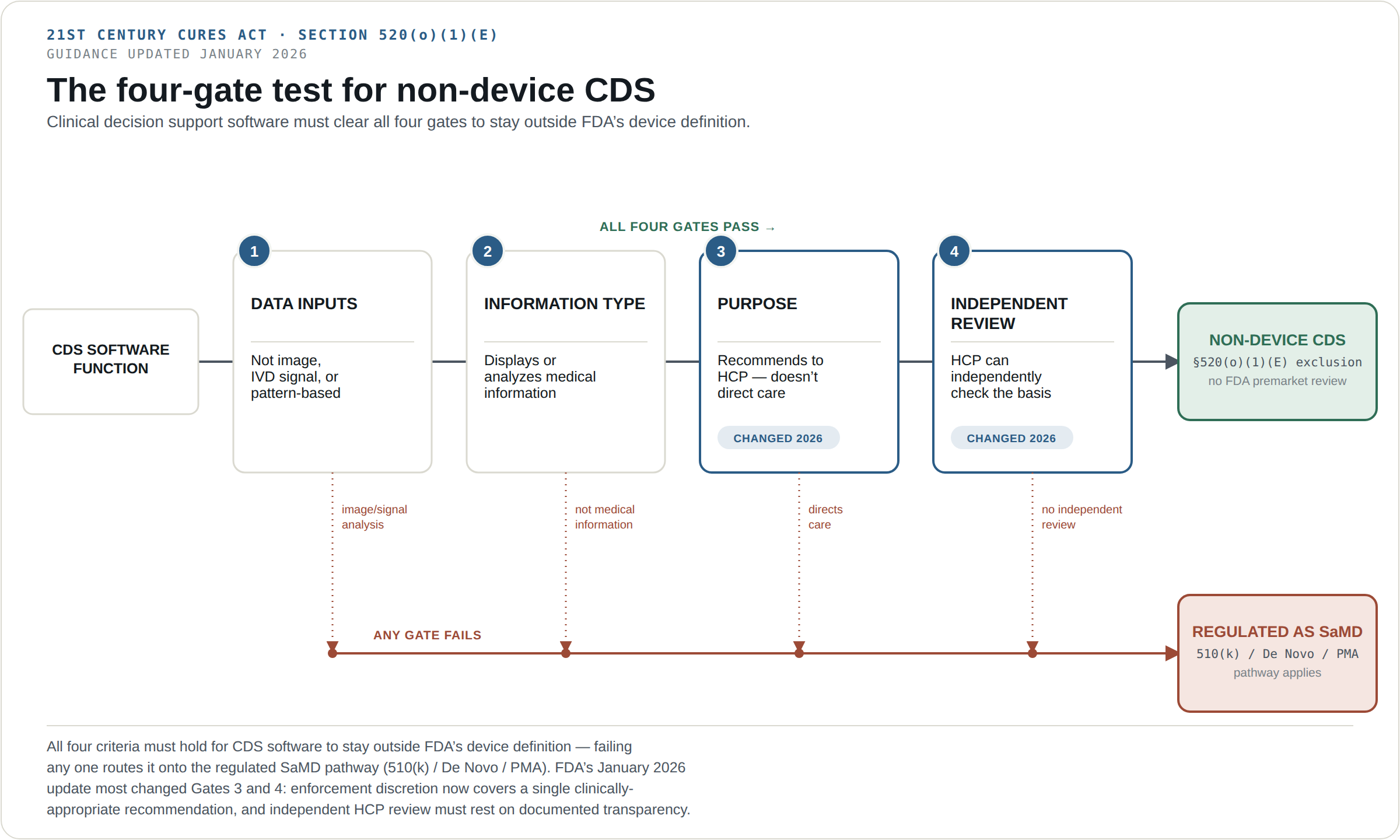
How to know if your device is Clinical Decision Support or SaMD
FDA SaMD Services
SaMD Classification & Pathway Strategy
Four-gate non-device CDS analysis against FDA's January 2026 revised criteria — confirm whether your software is a device at all before you build a submission around it
General wellness / non-device exclusion review under the same January 2026 guidance update
Risk classification, predicate search, and substantial equivalence strategy for 510(k) — or De Novo/PMA strategy where no predicate exists
Submission strategy for AI-enabled and patient-facing conversational (LLM) interfaces, informed by FDA's first such clearance in December 2025
A documented classification rationale you can defend if FDA's interpretation shifts
FDA AI/ML Guidance Transitions
Good Machine Learning Practice (GMLP) alignment review
Predetermined Change Control Plan (PCCP) drafting under the December 2024 final guidance, so planned model updates don't trigger a new submission every release
Submission positioning under FDA's draft Lifecycle Management and Marketing Submission guidance for AI-enabled device software functions — live since January 2025, still not final
Regulatory horizon monitoring: draft guidance comment periods, RFIs, and the non-device software boundary as FDA continues to redraw it
A roadmap built to absorb the next guidance update instead of getting rebuilt every time one drops
Compliance & Post-Market Maintenance
Post-market surveillance planning and adverse event / Medical Device Reporting (MDR) support
PCCP execution — managing approved model or software changes without triggering a new submission
Cybersecurity documentation and vulnerability management aligned to FD&C Act Section 524B premarket cybersecurity requirements
Labeling, algorithm transparency, and model documentation kept current as FDA's transparency expectations evolve
Change-control determinations: knowing when a software update crosses the line into a new submission
Who this is for
SaMD developers — especially those building AI-enabled or patient-facing software — who need a regulatory strategy built for where FDA's guidance is actually going, not a static classification that's already a guidance cycle behind.
The Benefit of Our Expert Support
-

Accelerate Time to Market
Understanding your certification and clearance pathway early avoids costly rework and delays that push launch dates back by months.
-

Protect Market Access
Maintaining CEHRT status and FDA clearance keeps your product sellable — losing either can pull you out of the market your customers depend on you to serve.
-

Minimize Regulatory Risk
Certification gaps or an incorrectly chosen FDA pathway can mean rejected submissions, enforcement action, or having to restart a filing from scratch.
-

Capitalize on Strategic Growth
As ONC and FDA both build out AI-specific pathways and standards, being ahead of those requirements positions your product as a trusted, compliant option in a fast-moving market.