Small Practices, Big Penalties: Toward a Fairer, Data‐Grounded Payment Model
I’ve been reviewing the most recent data on MIPS (Merit-based Incentive Payment System), and one trend stands out sharply. Small, rural, and solo practices are bearing a disproportionate share of penalties. As CMS pushes ahead with proposed changes, including refinements to cost measure attribution and a two-year "informational feedback" period for new cost measures, these practices may have an opportunity to catch a break. That depends on how system design, data, and advocacy align.
Whether you work in dermatology, chronic care, acute care, or within an ACO, you deserve a payment system that reflects your context. A system that disproportionately punishes smaller or under-resourced practices is not sustainable. Let’s discuss the evidence, what’s at stake, and actionable steps toward a more data-driven payment system.
1. What the Data Shows: Disproportionate Penalties for Small, Rural, Solo Practices
According to AMA data on 2025 payments (based on 2023 performance), 86% of MIPS-eligible clinicians avoided a penalty (Becker’s Physician Leadership).
Among those penalized:
• ~49% of solo physicians got penalized (AMA).
• ~29% of small practices were penalized.
• ~18% of rural practices.The severity is worse. Among those penalized, 13% of small practices and 29% of solo physicians received the maximum –9% penalty.
Specialty practices are especially exposed because many cost measure attribution methods misassign costs or fail to account for the ways specialists operate. The upcoming CMS proposals aim to address some of these attribution issues (MDInteractive.com).
In short, small and rural practices, especially solo or specialty groups, are not just more likely to be penalized. They are also more likely to be heavily penalized.
2. What CMS Is Proposing: Attribution and New Cost Measures’ Feedback Period
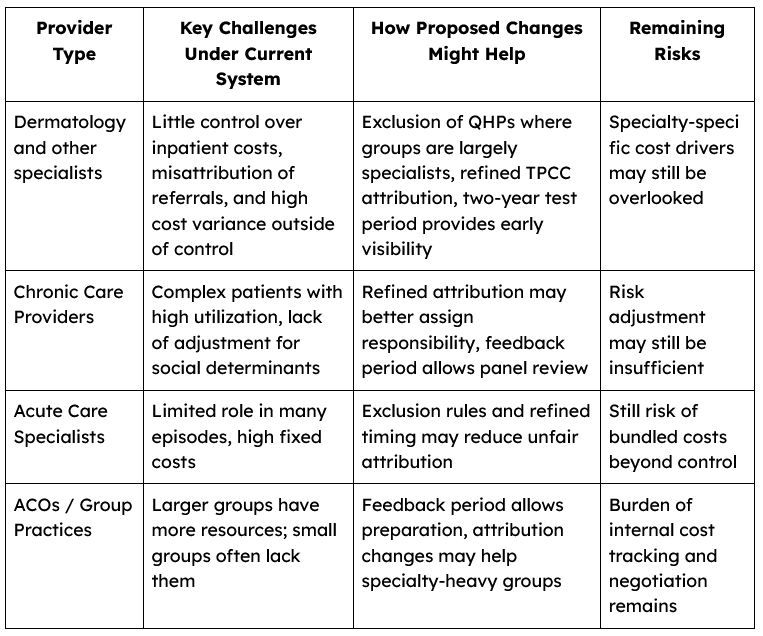
TPCC (Total Per Capita Cost) measure refinements: CMS proposes updates to attribution logic and service timing criteria. This is meant to better capture the relationships of care and reduce misattribution.
Exclusion of certain QHPs in specialty groups: For example, advanced practice professionals may be excluded from TPCC attribution if their group is comprises excluded specialists. This is intended to avoid attributing costs to groups that do not have meaningful control over that care.
Two-year informational-only feedback period for new cost measures: Any new cost measure finalized would first be used for feedback without becoming part of the MIPS score or affecting payment. This gives practices time to adjust before bonuses or penalties hinge on those measures.
CMS is not proposing to add or remove cost measures in 2026. The focus is on refining attribution and scoring.
3. Impact on Different Provider Types
4. What You Should Do Now: Actionable Strategies
Audit Your Cost Attribution Exposure. Review your current cost measure scores and identify where misattribution occurs.
Build Data Capacity. Ensure your systems can pull patient-level cost data and improve internal analytics.
Engage in Advocacy. Submit comments during the CMS public comment period. Be specific about misattribution and specialty workflow
Use the Feedback Period. Test your exposure under new cost measures before penalties apply.
Mitigate Risk. Explore alternative payment models and adopt best practices for efficiency now.
Collaborate and Share Best Practices. Join peer networks or partner with health systems for shared analytics.
Prepare for Specialty-Specific Cost Measures. Stay alert to measure development and participate in pilots where possible.
5. Possible Outcomes
If CMS attribution refinements and feedback periods succeed, we may see fewer harsh penalties for small, rural, and specialty practices. A fairer system would be more transparent and account for patient complexity, geography, and specialty norms. However, these changes require strong data practices and ongoing monitoring to prevent unintended harms.
The data sends a clear warning. Under current MIPS rules, small, rural, and specialty practices are marginalized. CMS’s proposed changes in attribution logic and cost measure feedback create an opening for fairness and transparency.
If you run a dermatology clinic, chronic disease practice, or acute care specialty, now is the time to act. Audit your exposure, strengthen your data, and use the feedback period strategically.
ChirpyBird believes in payment systems built on data, accountability, and equity. Subscribe to our newsletter and follow our insights. Let’s use this moment to turn regulatory change into opportunity, not risk.