APP Plus Measure: Controlling High Blood Pressure (CMS165v13)
High blood pressure (hypertension) remains one of the most common and modifiable risk factors for cardiovascular disease. Within the APP Plus quality measure set, CMS165v13 (“Controlling High Blood Pressure”) holds a key place. It bridges chronic care, preventive strategy, and value-based performance.
In this post, I’ll walk you through exactly how CMS165v13 works now, where practices often stumble, and what your ACO or practice can do today to optimize your control rates and defend your data in audit scenarios. We’ll explore both the clinical logic and the reporting mechanics.
1. What is CMS165v13? (Basic Definition & Rationale)
Measure Name & Identifier: CMS165, version 13 (NCQA / eCQM)
Population: Patients 18 to 85 years who have a diagnosis of essential hypertension (existing or new in the first six months of the measurement period).
Performance Metric (Numerator): The percentage of those patients whose most recent blood pressure reading in the measurement period is < 140/90 mmHg (i.e., systolic < 140 and diastolic < 90).
Denominator & Exclusions:
• Must have had a visit in the period and a qualifying hypertension diagnosis. (Quality Payment Program)
• Exclusions include ESRD, renal transplant, dialysis, pregnancy, hospice, long-term nursing home residents (age 66+), and advanced illness/frailty (for certain older age bands) under specific criteria.Why It Matters:
• High blood pressure is a leading upstream driver of stroke, MI, heart failure, and CKD.
• Better BP control reduces downstream costs and strengthens your cost category as well as quality.
• Because it is an outcome (intermediate clinical outcome) measure, missing control has a more substantial penalty potential than many process metrics.
2. What’s New in v13 (vs prior versions)?
Understanding version changes is critical; practices sometimes fail because their mapping or logic still reflects an older spec. Here are a few updates in v13 worth flagging:
Streamlined Advanced Illness Criteria: The 2025 version (v13) of the spec reduces the complexity of advanced illness exclusion, eliminating the requirement for “two outpatient encounters or one inpatient encounter” under certain conditions.
Library version updates: The specification updates supporting libraries (Hospice, Advanced Illness & Frailty, Outpatient Encounters) to newer versions to align timing and semantics, and remove legacy coding burdens.
Time comparison adjustments: The new rule enforces date-level precision (“day of” operator) instead of complete datetime precision, which helps address issues related to time zones or timestamp edges.
Telehealth eligibility reaffirmed: CMS allows BP readings to count even in telehealth contexts, provided the readings come from accepted devices or interfaces.
These changes may seem technical, but they can affect denominator/exclusion logic or how your EHR selects readings. If your workflow was tuned to an earlier spec, audit or submission mismatches can result.
3. Key Reporting Rules & Data Capture Pitfalls
To succeed with CMS165v13, your clinical workflows and data flows must align precisely. Here are several nuanced rules and common pitfalls worth knowing.
3.1 Acceptable BP Sources & Remote Monitoring
The numerator only accepts readings from clinician-measured or automated/remote devices that can reliably transmit or integrate. Readings entered manually by patients (e.g., via a patient portal) without the signature of device reliability may not be counted.
If multiple readings occur on the same date, the system should select the lowest systolic and diastolic pairs. That becomes the “most recent control” reading.
Readings taken during acute inpatient stays or ED visits do not count.
3.2 Denominator Exclusion Edge Cases
Patients 66 and older who are long-term nursing home residents can be excluded.
Patients 66–80 with frailty + advanced illness may be removed if they meet combined thresholds.
Pregnancy, ESRD, palliative care, or hospice presence excludes.
One mistake: practices sometimes attempt to exclude “fragile elderly” too broadly; ensure the criteria line up with what the spec allows, not your internal intuition.
3.3 Timing & No-Measurement Approach
If no BP reading occurs during the measurement period, the patient is assumed uncontrolled (i.e., counts against the numerator).
Diagnostic or procedural days: Avoid including BP readings taken on a day of therapeutic/diagnostic procedure if that procedure triggers a diet/medication change (except for “common low intensity / preventive” procedures).
3.4 Data Mapping & EHR Logic
Ensure that BP vital fields in your EHR map to the correct data element semantically (i.e., numeric systolic/diastolic fields, not free text).
Avoid rounding, ranges, or “less than” fields (these don’t count; the spec requires a distinct numeric result for both values).
Confirm that your EHR’s logic for picking “most recent” respects the “lowest on same day” rule.
4. Best Practices to Optimize Performance
Here’s a practical playbook: strategies your ACO or practice can implement now to raise controlled BP rates and minimize data loss.
4.1 Proactive Workflow & Protocol Design
Team-based care models: Use medical assistants or nurses to confirm BP readings as patients check in.
Repeat check policy: If the initial reading is high, allow a standardized second check (after rest) and record it.
Device standardization: Use validated, interoperable BP devices that can interface with EHR or remote monitoring platforms.
Reminder alerts: Set EHR prompts for patients who have missed a BP measurement in a quarter.
4.2 Retrospective Chart Review & Catch-up
Midyear, run a gap report showing patients without BP readings or uncontrolled values, and schedule outreach visits.
For patients with no readings, reach out to record a valid BP (in office or via a trusted device) before year-end.
Prioritize patients near the cutoff (e.g. 138/88) for interventions (med adjustment, counseling) to push them under the threshold.
4.3 Documentation and Evidence Preservation
Preserve audit-ready logs: screenshot your EHR BP value flows, device interfaces, and mapping rules.
Keep trend graphs or notes that show your team’s follow-up (especially for outliers).
Document logic for exclusions (e.g., a note explaining why a patient qualifies for exclusion by frailty/advanced illness).
4.4 Use “What-If” Modeling
Export your denominator and numerator data quarterly and run simulations under different scenarios (e.g., if you change medications or add visits).
Use these projections to shift staff time to patients who yield the greatest marginal improvement in your measure.
5. Audit & Validation Risks (And How to Defend Against Them)
Even if your rates appear favorable, a failed data validation could still cost you. Here are the common audit flags, along with strategies for defending against them.
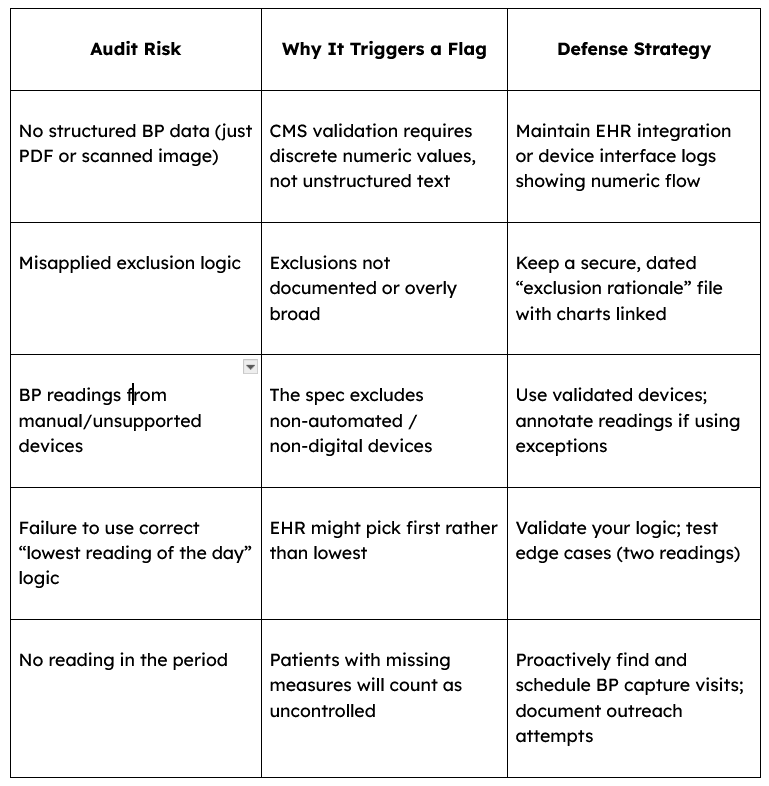
A good validation defense is not reactive — it’s baked in from Day 1 of the period.
6. Bonus Insights & Competitive Differentiators
To set your content apart from competitors like ChartLogic or Intrinsiq, here are a few deeper angles you can weave in:
Hybrid remote/In-office strategy: Many practices now struggle with hybrid care. Emphasize the need to validate and audit remote BP device integrations under CMS rules. (Not all vendors provide full traceability.)
Temporal “data drift” checks: Over the year, measurement logic might drift (EHR updates, interface changes). Schedule periodic audits to catch mapping changes.
Peer benchmarking & decile analysis: APP Plus will score you by decile among peers. Running comparative benchmarks against your ACO peers can help you understand how incremental improvements (e.g., moving from the 60th to the 70th percentile) can disproportionately shift your score.
Resource allocation modeling: Show how to invest staff time optimally — i.e., which patient cohorts give the best ROI in control improvement.
Mastering CMS165v13: Controlling High Blood Pressure isn’t just about clinical excellence; it’s about aligning care operations, data flow, and audit readiness. It’s the savvy practice that gets ahead of these details early that will not only boost their quality scores but also protect against late surprises in validation.